Walk down almost any street in Victoria and you’ll pass the same handful of trees: towering Douglas firs, twisted Garry oaks, peeling red arbutus, and of course the flowering cherries everyone takes photos of in February.
Our crew handles tree pruning and inspections on these trees every day. Here’s a field guide to the ones you’re most likely to have in your yard, how to tell them apart, and what each one needs to stay healthy.
Victoria’s Trees at a Glance
| Tree | Native? | How to spot it | Protected in the City of Victoria? |
|---|---|---|---|
| Garry oak | Yes | Gnarly, twisting limbs; deeply lobed leaves; grey furrowed bark | Yes, once over 50 cm tall |
| Arbutus | Yes | Peeling red-orange bark; glossy evergreen leaves | Yes, once over 50 cm tall |
| Douglas fir | Yes | Tall and straight; cones with three-pointed “mouse tail” bracts | Yes, over 30 cm diameter |
| Western redcedar | Yes | Flat, scaly sprays of foliage; stringy red-brown bark | Yes, over 30 cm diameter |
| Bigleaf maple | Yes | Huge leaves (often 30 cm across); mossy trunks | Yes, over 30 cm diameter |
| Grand fir | Yes | Flat needles in two neat rows; citrusy smell when crushed | Yes, over 30 cm diameter |
| Pacific dogwood | Yes | Big white spring flowers; BC’s provincial flower | Yes, once over 50 cm tall |
| Flowering cherry and plum | No | Pink or white spring blossoms; shiny banded bark | Yes, over 30 cm diameter |
| Horse chestnut | No | Big hand-shaped leaves; conkers in fall | Yes, over 30 cm diameter |
| Birch | No | White papery bark; small triangular leaves | Yes, over 30 cm diameter |
Diameter is measured at 1.4 m above the ground. Other municipalities use different rules, so check the tree permit and bylaw rules for your area, or our post on what trees are protected in Victoria.
What’s Actually Lining Our Streets
Our street trees are a different story from our backyards. A 2009 study of Victoria’s street trees found the city’s boulevards were dominated by a few groups:
| Tree group | Share of street trees |
|---|---|
| Cherries and plums (Prunus) | 29.4% |
| Maples (Acer) | 10.1% |
| Hawthorns (Crataegus) | 9.6% |
| Birches (Betula) | 8.1% |
| Oaks (Quercus) | 7.2% |
| Horse chestnuts (Aesculus) | 7.2% |
Nearly a third cherries and plums. That’s where the blossom season comes from. The City has been planting a wider mix since then, but those old boulevard cherries are still everywhere.
Our Native Trees
Garry Oak (Quercus garryana)
The tree Oak Bay is named after, and probably the most loved tree in the region. Garry oak meadows are one of the rarest ecosystems in Canada, and almost all of what’s left is here on the South Island and the Gulf Islands.
- Care: slow growing and very long lived. They need very little pruning, and only light cuts in winter.
- Watch for: summer irrigation under the canopy (it invites root rot), soil compaction, and construction in the root zone.

Arbutus (Arbutus menziesii)
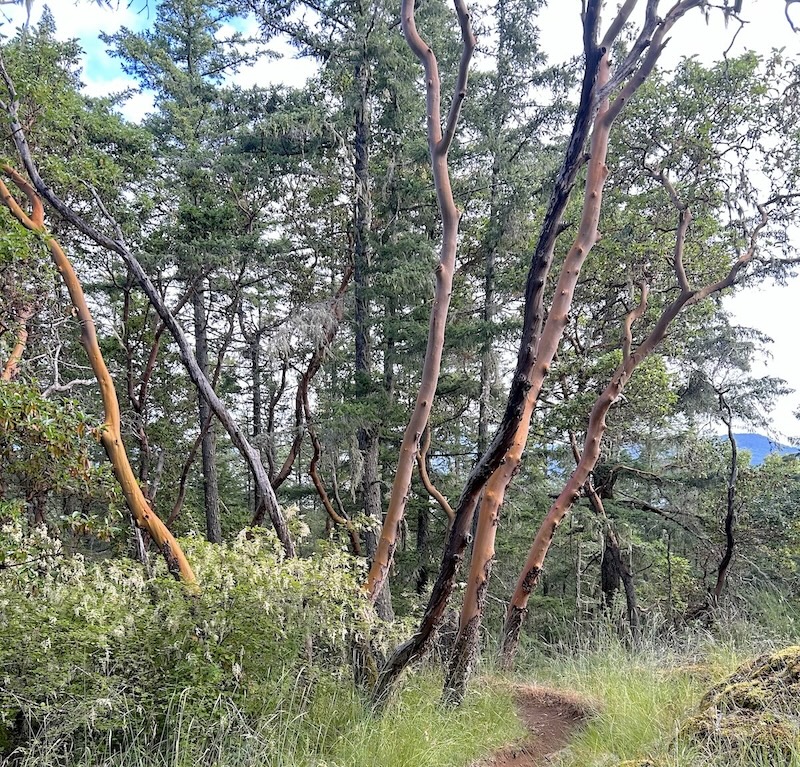
Canada’s only native broadleaf evergreen. Arbutus loves rocky, sunny, dry spots and peels its bark every summer. That’s normal, not a sign it’s dying.
- Care: minimal pruning, done in dry weather. No summer watering once it’s established.
- Watch for: leaf spot and blight in wet springs, and dieback when the roots are disturbed. They hate being dug around.
Douglas Fir (Pseudotsuga menziesii)
The big one. Douglas firs make up a lot of the tall canopy around Greater Victoria, especially in Saanich, View Royal and the Highlands. They’re well adapted to our climate and handle winter weather in stride.
- Care: deadwood removal and occasional crown thinning for wind and clearance.
- Watch for: laminated root rot, and trees left exposed when neighbours are cleared (windthrow risk). Never top a fir.

Western Redcedar (Thuja plicata)
BC’s official tree. Cedars love moisture, and that’s becoming a problem. Long dry summers are hitting them hard, especially on drier sites.
- Care: deep summer watering for trees on dry sites, and mulch over the root zone.
- Watch for: browning from the top down and thinning crowns. Those are drought signals worth acting on.
Bigleaf Maple (Acer macrophyllum)
Fast growing with massive leaves and mossy, fern-covered trunks. Beautiful, but they grow big heavy limbs quickly, and that can become a problem over houses and driveways.
- Care: regular inspections and end-weight reduction on long limbs. Prune in midsummer or early winter to avoid heavy sap bleeding.
- Watch for: decay at old pruning wounds and branch unions, and big limbs failing in summer.
Grand Fir (Abies grandis)
Common in older neighbourhoods and one of the trees struggling most with our drier summers. We wrote a full guide to grand fir disease in Victoria covering the warning signs.
Pacific Dogwood (Cornus nuttallii)
Our provincial flower. Lovely but fussy: Pacific dogwoods are prone to anthracnose (a fungal leaf disease) in wet springs and don’t love being moved or crowded.
The Ornamentals
Flowering Cherries and Plums
The stars of February and March. Many of the older boulevard and backyard cherries are now reaching the end of their natural lifespan, which is fairly short for a tree.
- Care: prune in dry summer weather, never in wet winter conditions.
- Watch for: bacterial canker (oozing gum and dying branches), silver leaf, and decay in old trunks.
Maples (Norway, Red and Japanese)
Tough, adaptable and everywhere. Norway maples can develop girdling roots and dense crowns. Japanese maples are small, slow and best pruned lightly by hand.
Birch
Popular for the white bark, but birches are shallow rooted and thirsty. In dry summers they’re often the first to show stress with yellowing leaves and dieback at the top.
Horse Chestnut and Hawthorn
Horse chestnuts often turn brown and blotchy by late summer from leaf blotch. It looks bad but is mostly cosmetic. Hawthorns are tough little street trees, though the thorns make pruning them a prickly job.
Not Sure What You’ve Got?
Knowing your tree changes everything: when to prune it, whether to water it, and whether you need a permit to touch it. If you’re unsure, snap a photo of the leaves, the bark and the whole tree. Or let us take a look.
Want an Expert Eye on Your Trees?
Our ISA Certified Arborists can identify your trees, check their health, and tell you what each one needs. Book a tree health inspection, or ask about tree pruning for oaks, arbutus and fruit trees.
Need an arborist Victoria homeowners can count on? We also work in Oak Bay, Saanich and Esquimalt.
Call us at 778-561-4502 or book a free site visit.