
Yes, and yes. Mostly.
Watering and mulching are two of the cheapest, easiest things you can do for your trees. Done right, they’ll do more for a tree’s long-term health than almost anything else you can buy. Done wrong (too much water in the wrong place, mulch piled against the trunk) they can quietly cause the problems you were trying to prevent.
Here’s what we tell homeowners on our tree health inspections around Greater Victoria.
The quick version
- Young trees (first 3 years): water them through every dry spell, no exceptions.
- Established ornamentals: a slow, deep soak every few weeks in a drought.
- Mature Garry oaks and arbutus: leave them dry in summer. They’re built for it.
- Mulch almost everything: 5 to 10 cm of wood chips, spread wide, kept off the trunk.
Why Watering Matters More in Victoria Than It Used To
We get plenty of rain, just not when trees need it most. Most of it falls between October and April. Then we get months of dry weather, and lately those dry spells have been longer and hotter.
Some of our native trees are feeling it. Saanich’s 2024 Urban Forest Strategy calls out grand fir, western redcedar and western hemlock as native species struggling with drier summers. We see it on jobs every year: browning cedars, thinning firs, and drought stress opening the door to pests and disease. Our post on grand fir disease in Victoria goes into one of the worst examples.
Which Trees Need Watering (and How Much)
| Tree | How much | How often in dry weather |
|---|---|---|
| Newly planted (0 to 3 years) | About 20 litres per watering, aimed at the root ball | Twice a week (this is Saanich’s recommendation for young trees) |
| Established ornamental trees (cherries, maples, birch, dogwood) | A slow, deep soak across the root zone | Every 2 to 4 weeks in a long dry spell |
| Drought-stressed conifers (cedar, grand fir, hemlock) | A long, slow soak with a soaker hose under the canopy | Every 2 to 3 weeks through July and August |
| Mature Garry oak and arbutus | None in summer | Leave them be. More on this below. |
Every site is different. Sandy soil drains fast, clay holds water. The easiest test is to dig down 10 to 15 cm near the edge of the canopy. If it’s dry at that depth, it’s time to water.
How to Water a Tree Properly
- Go slow and deep. A soaker hose or a trickling garden hose left for an hour beats a quick spray. You want water getting 30 cm or more into the soil.
- Water the root zone, not the trunk. Most feeder roots sit in the top 30 cm of soil and spread well past the canopy edge. Water where the roots are.
- Water early in the morning or in the evening so less is lost to evaporation.
- Don’t rely on the lawn sprinkler. A quick daily sprinkle encourages shallow roots and does little for trees.
What the CRD Watering Rules Allow
Stage 1 watering restrictions run from May 1 to September 30 every year across the Capital Region. The good news for tree owners: trees and shrubs get more leeway than lawns.
| Method | Trees and shrubs under Stage 1 |
|---|---|
| Hand watering (hose with a shut-off nozzle, watering can) | Any day, any time |
| Drip or micro-irrigation, soaker hoses | Any day, any time |
| Sprinkler | Any day, 4 to 10 am or 7 to 10 pm |
Restrictions can tighten in a bad drought year, so check the CRD’s current watering schedule before you set anything up.
The Big Exception: Garry Oaks and Arbutus
This one surprises people. Our two most iconic native trees grew up with dry summers, and they like it that way.
Regular summer watering around a mature Garry oak or arbutus (often from a lawn or garden bed planted under it) keeps the soil warm and wet, which is exactly what root rot fungi love. We see a lot of declining oaks with a thirsty lawn and a sprinkler system right under the canopy.
If you have a mature oak or arbutus, the best thing you can do is protect the root zone, keep irrigation away from it, and replace lawn under the canopy with mulch or drought-tolerant native plants. Young, newly planted ones are different. Water them until they’re established.

Signs Your Tree Is Thirsty (or Drowning)
| Too little water | Too much water |
|---|---|
| Leaves wilting or curling in the afternoon | Yellowing leaves that drop early |
| Crispy brown leaf edges | Soil that stays soggy days after watering |
| Early fall colour in July or August | Mushrooms or fungal growth at the base |
| Browning needles at conifer branch tips | Sparse new growth and dieback |
Some symptoms look the same either way. If you’re not sure, a tree health inspection will tell you what’s going on before you make it worse.
Should You Mulch? Absolutely
Mulch is the closest thing to a forest floor most city trees will ever get. A good layer:
- Holds moisture in the soil through dry spells
- Keeps roots cooler in summer and buffers winter freeze and thaw
- Smothers grass and weeds that compete for water
- Breaks down slowly and feeds the soil life that trees depend on
- Keeps the mower and string trimmer away from the trunk
How to Mulch a Tree
- Clear the grass from the area you want to cover.
- Spread 5 to 10 cm of mulch, as wide as you can manage. Out to the edge of the canopy is ideal. Even a 1 m circle helps.
- Pull it back from the trunk so there’s a gap of about 10 cm and you can see the root flare (where the trunk widens into the roots).
- Top it up once a year as it breaks down. Rake the old stuff first so it doesn’t get too deep.
The number one mistake we see is the “mulch volcano”: a big cone of mulch piled up against the trunk. It keeps the bark wet, invites rot and rodents, and can lead to girdling roots. Doughnut, not volcano.
Which Mulch Is Best?
| Mulch | Verdict | Notes |
|---|---|---|
| Arborist wood chips | Best | A mix of wood, bark and leaves. Breaks down slowly and builds great soil. |
| Shredded or fine bark mulch | Good | Looks tidy. Breaks down faster, so top it up more often. |
| Fallen leaves | Good (and free) | Shred them first so they don’t mat down. |
| Rock or gravel | Avoid | Heats up in summer and adds nothing to the soil. |
| Landscape fabric under mulch | Avoid | Stops organic matter reaching the soil and roots grow into it. |
| Rubber mulch | Avoid | Doesn’t break down, doesn’t feed anything. |

Protect the Roots While You’re At It
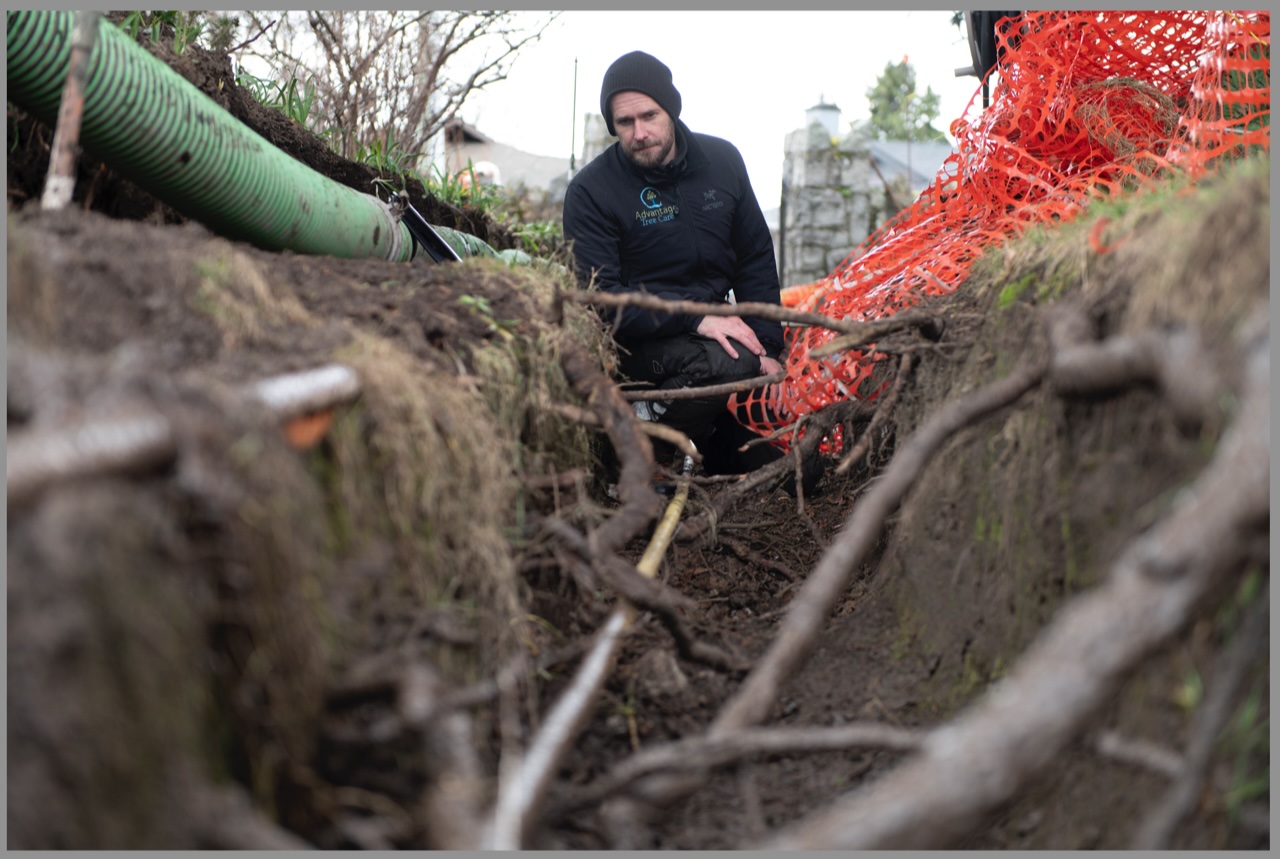
Water and mulch only help if the roots are healthy enough to use them. Compacted soil (from cars, foot traffic or construction) squeezes out the air roots need. If a tree has been struggling after a reno or a new driveway, we can use air-spading to loosen compacted soil and check the roots without cutting them.
Quick Answers
Should I fertilize a drought-stressed tree? No. Fertilizer pushes new growth the tree can’t support without water. Fix the water first. (More on that in are you over-fertilizing your fruit trees?)
Do I need to water in winter? Usually not in Victoria. The exception is a dry spell before a hard freeze. Moist soil holds heat better than dry soil.
Can I just water the lawn and let the tree share? Not really. Lawn watering is shallow and frequent. Trees want the opposite.
Worried About a Tree That’s Struggling This Summer?
Browning needles, early leaf drop or thinning canopies can be drought, or they can be something more serious. Our ISA Certified Arborists can work out which, and what to do about it. Book a tree health inspection, or ask about tree pruning to take dead wood out safely.
Looking for tree care Victoria homeowners can rely on? We also cover Saanich, Langford and Sidney.
Call us at 778-561-4502 or book a free site visit.